New album comes out October 23, 2026!
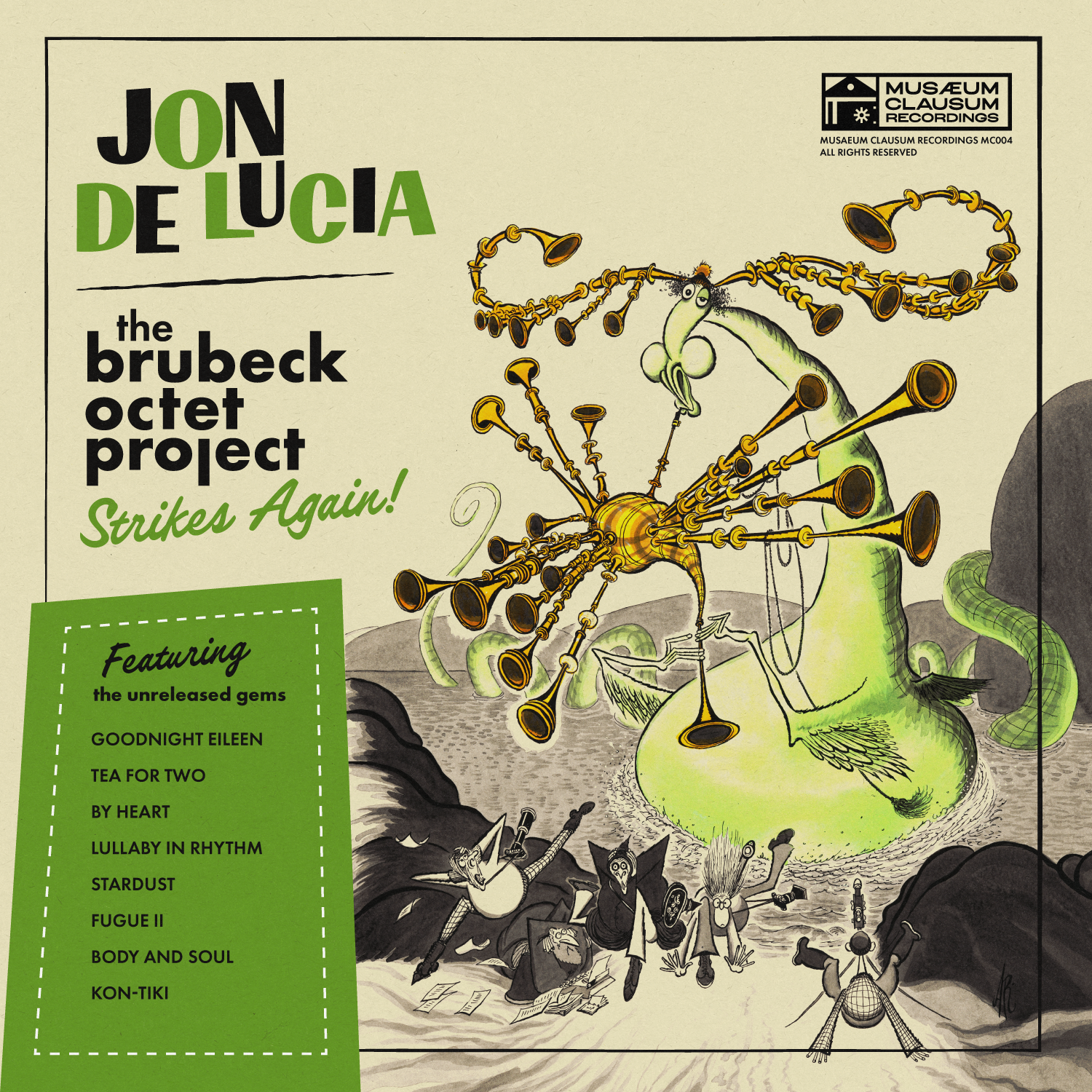
The Brubeck Octet Project Strikes Again!
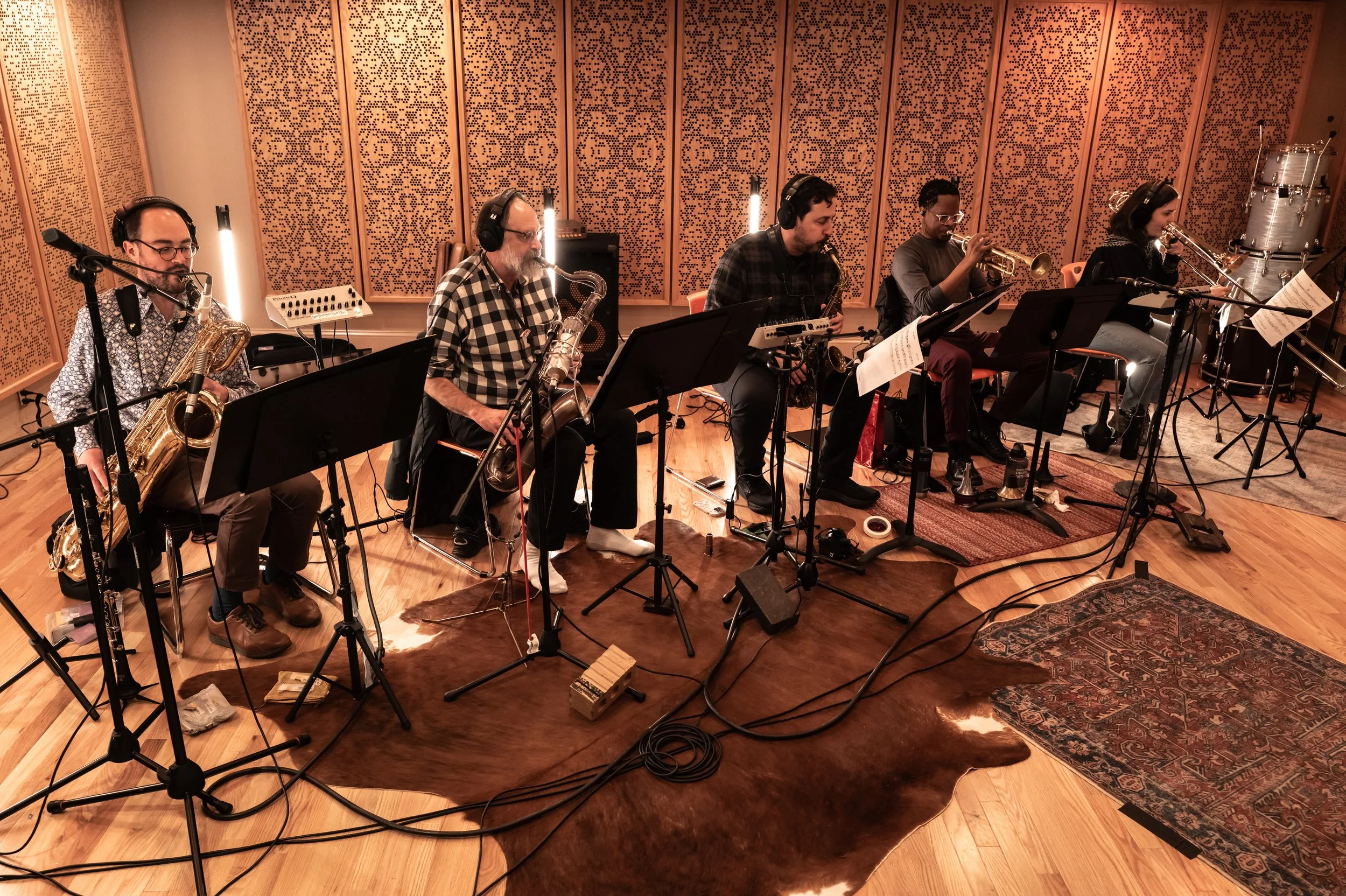
In 2024, Jon De Lucia released The Brubeck Octet Project. This was a recreation and rearrangement of the recorded output of the original Dave Brubeck Octet, a lesser known group that rivaled the Birth of the Cool Nonet in 1948-49. Even less documented is the fact that the Brubeck Octet in fact lasted until 1953, and recorded a number of charts that have never been heard, most of which is lost. Through archival research, De Lucia has unearthed 11 more arrangements for this release, and recorded them with the same stellar lineup that includes Brandon Lee, Scott Robinson, Becca Patterson, Jay Rattman, Glenn Zaleski, Daniel Duke and Keith Balla. The Brubeck Octet Project Strikes Again is a spectacular and thoughtful reimagining of the original group.
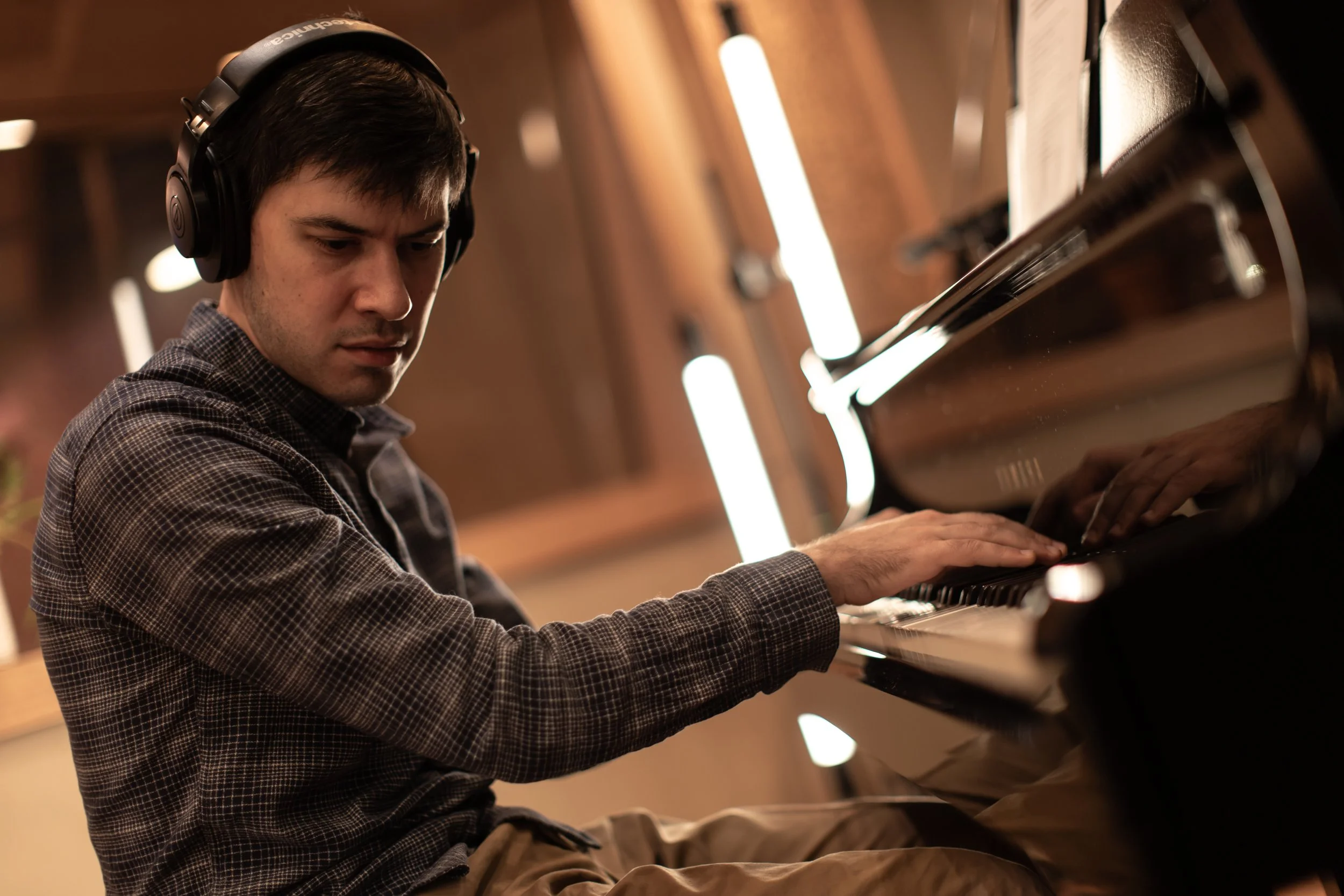
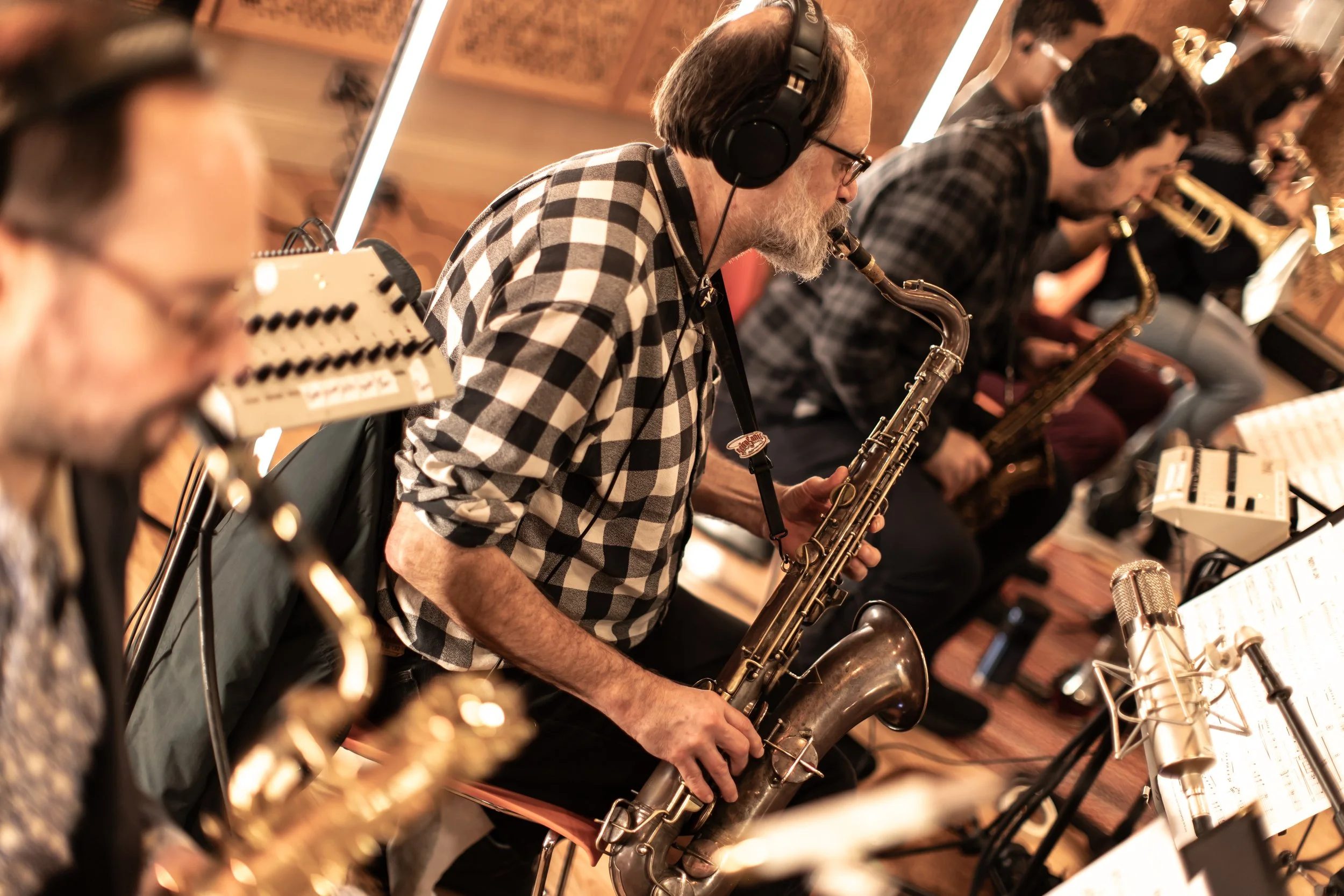
The album opens with “Goodnight Eileen” a fascinating polytonal blues by Octet tenorist Dave Van Kriedt, followed by “Happy in Love,” a Glenn Miller hit in which De Lucia has worked in the shout chorus to George Wallington’s “Godchild,” capturing the essence of 1949 in one chart. Zaleski leads off an epic arrangement by clarinetist Bill Smith of “Tea for Two,” which includes an uptempo feature for Birdland and Village Vanguard Orchestra trumpeter Brandon Lee. Smith’s writing incorporates all kinds of triad layerings in the style of Stravinsky, ahead of its time.
New to this album is the inclusion of an original arrangement by De Lucia. “By Heart,” is a contrafact on “My Heart Stood Still,” and employs many of the devices of polymeter and counterpoint used by the original octet. Multi-instrumentalist Scott Robinson plays an excellent tenor solo, and drummer Keith Balla (Samara Joy, Pasquale Grasso) leads the end of the tune.
Then it is back to two unique arrangements by Bill Smith, the only member of the Octet that had spent time on 52nd St before the formation of the group, and it shows. His take on “I Want To Be Happy,” features Robinson again, and and twisted solo from Glenn Zaleski, who actually knew and studied with Brubeck. “Lullaby in Rhythm” takes the Benny Goodman hit and warps its melodic rhythm, adding folk themes (Mairzy Doats) in true modernist fashion, as Smith would do on later Brubeck albums like The Riddle. Lee is the star soloist here. “Stardust“ was originally a feature for Paul Desmond, written by Smith. The parts were incomplete, so De Lucia carefully reconstructed this to feature the sweet tone of his own alto playing. The group operates in concerto fashion, responding to De Lucia’s solo lines with clever interjections.
No Brubeck Octet album would be complete with out a jazz fugue. Though only "Fugue on Bop Themes” was released, Van Kriedt actually wrote 5 fugues for the group. This one is simply called, “Fugue II,” and again features the sprightly alto of De Lucia, while the difficult clarinet lead is held down by Jay Rattman, who then takes us into another charming and strange ballad performance of “Body and Soul,” originally written to feature trombonist Bob Collins, here featuring the warm sound of Becca Patterson. Note at the end how the trumpet and trombone melodies deliberately clash, another trademark trick of the Octet writers.
The Octet lasted until the end of 1953, and their repertoire grows more varied, embracing the trends of the time, including latin rhythms! Kon-Tiki is a charming tune by Dave Van Kriedt, who ended up leading the Octet in the end. This was added at the end of a long day of recording, without rehearsal, and it turned out to be one of the stand out tunes of the session.
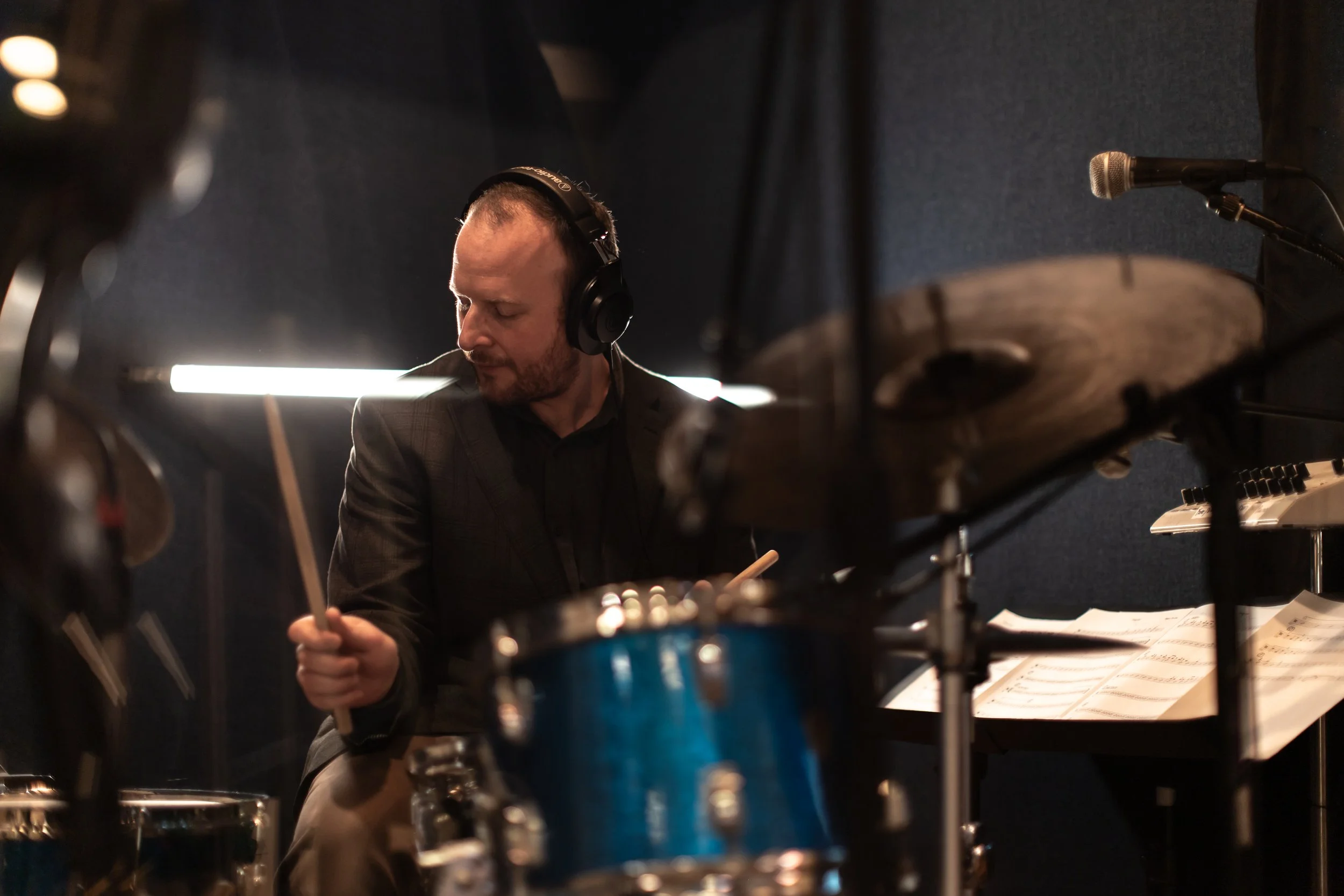
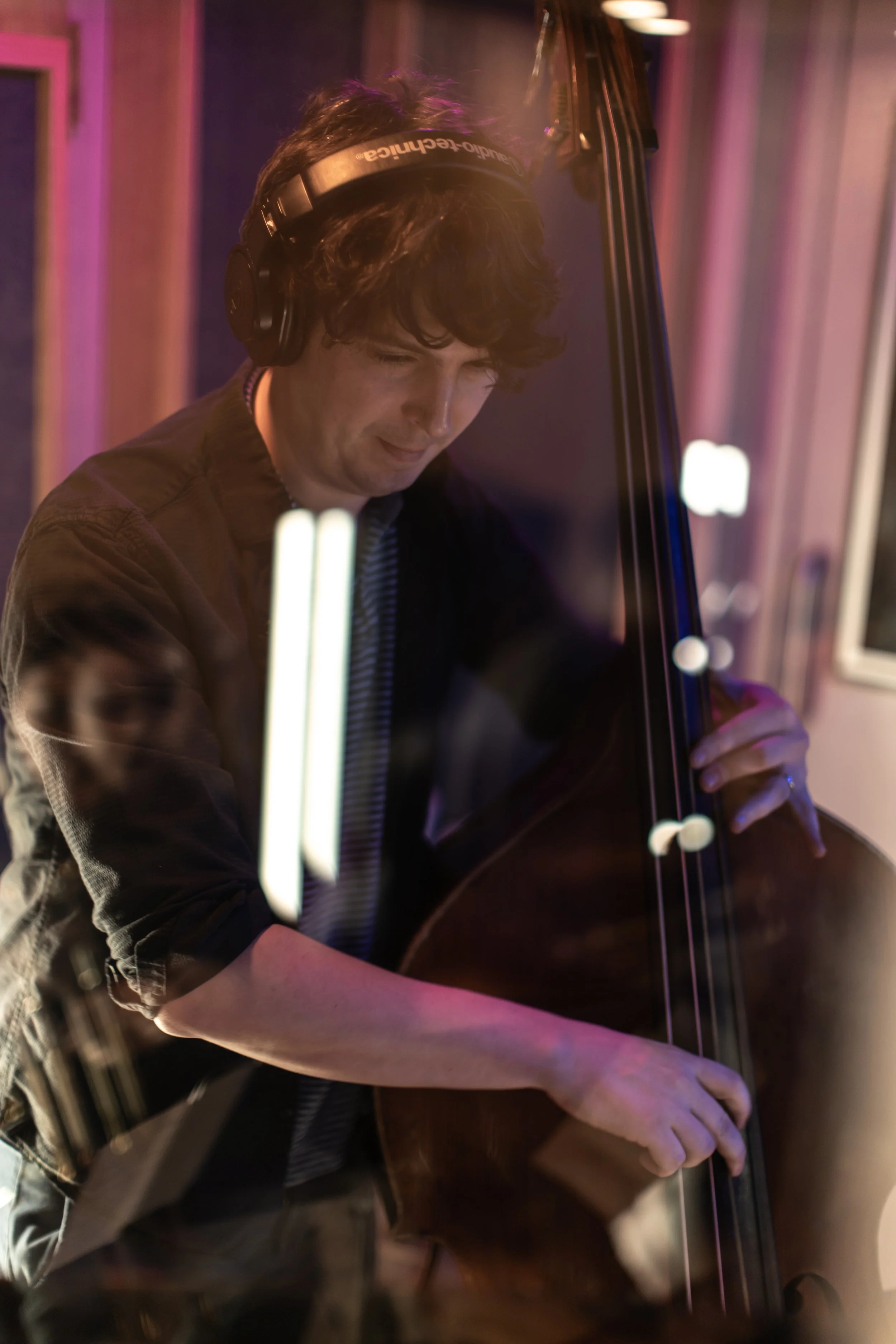
The album closes with bassist Jack Weeks arrangement of “Perdido,” know by later Brubeck Quartet recordings with Paul Desmond, but originally done for the Octet. Balla’s playing is superb, and he holds up the session throughout, along with bassist Daniel Duke.
It should be mentioned also that the cover art for this album was provided by nonagenarian and original Brubeck cover artist, Arnold Roth. De Lucia has corresponded with “Arnie” and was delighted to be given permission to use this Loch Ness monster as the cover.
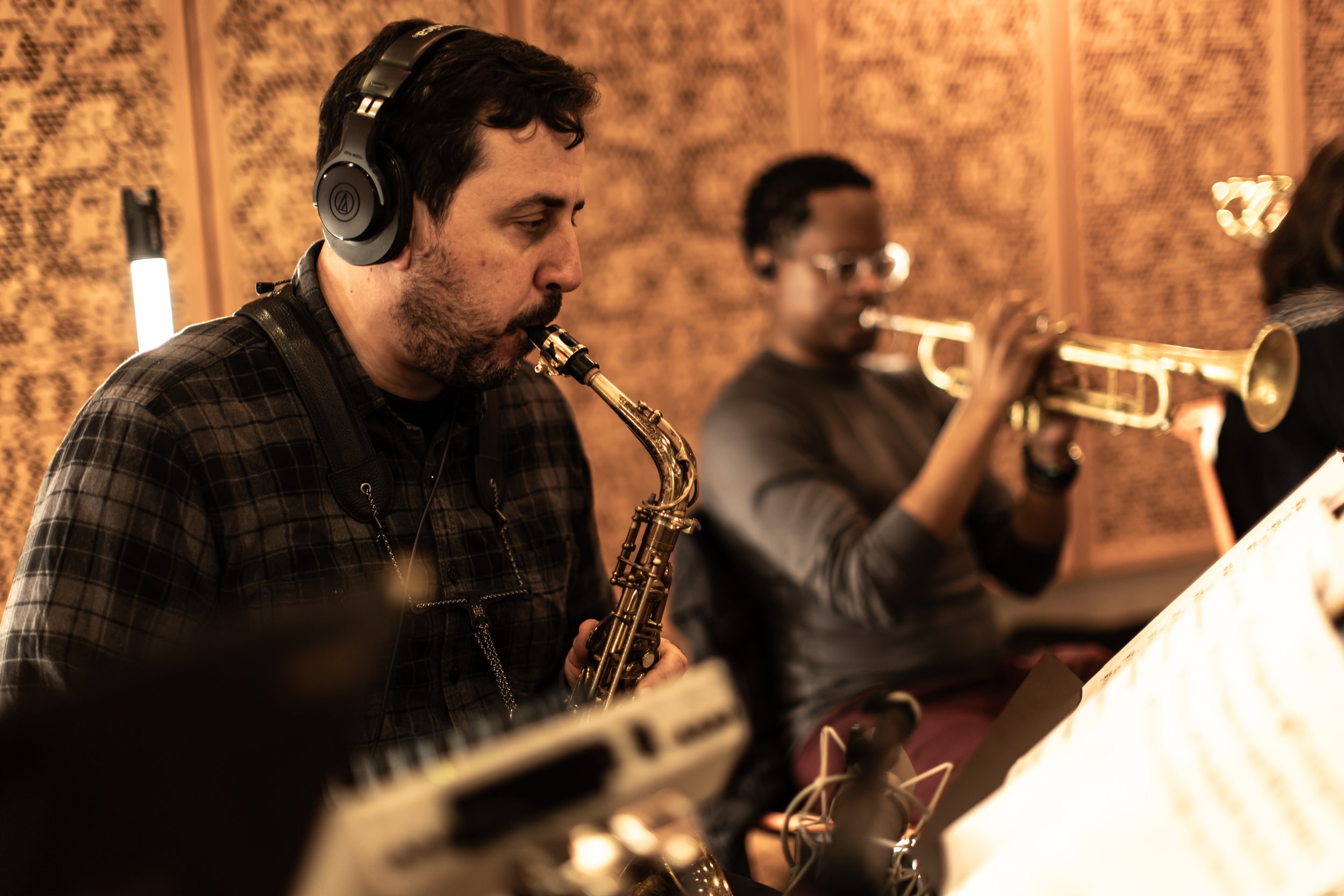
Photos by Adrien Tillman.
ORIGINAL 2024 ALBUM NOTES: As one of the most famous and prolific jazz musicians of the 20th century, Dave Brubeck was so well documented there would seem to be precious few unexplored corners of his career. But Brooklyn alto saxophonist Jon De Lucia, a musician drawn to overlooked musical nooks and crannies, has uncovered and refurbished the long-neglected arrangements that launched Brubeck’s career in the late 1940s as a classical-curious student studying composition at Mills College on the GI Bill. The Brubeck Octet Projecttakes a fresh look at the West Coast’s alternative to Miles Davis’s epochal Birth of the Cool sessions with a cast of heavyweight improvisers including tenor saxophone great Scott Robinson.
Before gaining fame on the college circuit with his quartet in the mid-1950s, Brubeck was an experimentally minded player drawn to Oakland’s Mills College by French composer Darius Milhaud. The Octet started as a school project first known as the Jazz Workshop Ensemble and later as The Eight, and finally as the Dave Brubeck Octet. And like Davis’s contemporaneous sessions that came to be known as Birth of the Cool, the octet’s 1946-50 recordings were first released piecemeal before Fantasy compiled the tracks on the 1956 12-inch LP Dave Brubeck Octet.
While hewing close to the original charts, De Lucia opens up the long-buried material with space for solos, essentially reconducting Brubeck’s experiments from a 21st-century perspective. The resulting album unfolds with the flow and coherence of a well-conceived set, opening and closing with Brubeck’s walk-off theme “Curtain Music.” There are fascinating arrangements of standards, from the lapidary take on Gershwin’s “Love Walked In” to the warp-and-weft melodic lines of Arlen’s “Let’s Fall in Love,” which opens with the horns unaccompanied. Both of those arrangements are by tenor saxophonist Dave Van Kriedt (more about him soon).
Brubeck’s group was stocked with future luminaries, like clarinetist/composer Bill Smith, who contributed the arrangement of Cole Porter’s “What Is This Thing Called Love?” (which opens with clattery melancholy before Robinson takes over with a spritely tenor solo). Drummer Cal Tjader went on to renown as a Latin jazz–loving vibraphonist and bandleader, while alto saxophonist Paul Desmond’s deliciously dry sound defined the Dave Brubeck Quartet during the height of its fame.
Brubeck’s sole arrangement, besides his original “Curtain Music,” is Kern’s “The Way You Look Tonight,” a chart marked more by a dense thicket of rapidly moving lines than lithe syncopation. It turns out the driving force behind the Octet’s sound was Van Kriedt, a mysterious and remarkable figure that De Lucia has rescued from obscurity. Responsible for the lion’s share of the Octet arrangements, the tenor saxophonist was born in Berkeley and ended up studying composition at Mills with Milhaud. He contributed two originals to the Octet’s book, the sensuous ballad “Prelude” (a gorgeous feature for De Lucia) and “Fugue on Bop Themes,” a piece that Igor Stravinsky used to illustrate counterpoint while lecturing at UCLA in 1951.

A highly accomplished multi-instrumentalist, Van Kriedt resurfaced on Brubeck’s 1957 album Reunion, a quintet session featuring eight Van Kriedt compositions, including “Prelude.” But by the end of the decade he had moved to Tasmania, and De Lucia found letters from him to his former boss in the Brubeck Archives. “He sounds isolated, living in this farmhouse that’s remote even in Tasmania,” De Lucia said. “But he kept writing and composing.”
De Lucia’s band features a stellar cross-section of New York talent, including trumpeter Brandon Lee, who’s showcased on two Grammy Award–winning albums by the Christian McBride Big Band, and trombonist Rebecca Patterson, who divides her time between Broadway pit orchestras and creative combos like Charlie Rosen’s 8-Bit Big Band. Jay Rattman’s clarinet and baritone saxophone work reveals a highly expressive player with a knack for blending with other winds.
Pianist Glenn Zaleski is one of the most sought-after accompanists on the New York scene, and bassist Daniel Duke is a highly versatile player who’s recorded with brass expert Corey Wilcox and saxophonist Nicole Glover. Rising drummer Keith Balla, who regularly supports Samara Joy and Pasquale Grasso, rounds out the rhythm section. Aside from De Lucia, the standout voice is Scott Robinson, whose longtime position holding down the baritone sax chair in the Maria Schneider Orchestra has indelibly linked him to the imposing horn. But given his druthers he prefers to play tenor, and he delivers consistently supple ensemble work along with a series of pithy solos.
De Lucia has explored many different musical idioms and styles within jazz and far beyond, but it’s not hard to trace his path to the Octet. Over the past decade his baroque improvising Luce Trio has examined the music of Bach, Handel, Jimmy Giuffre, and John Lewis, following his fascination with “this contrapuntal classical jazz,” De Lucia says. He started exploring octet arrangements to play the music from the 1959 album Lee Konitz Meets Jimmy Giuffre, which culminated with a performance featuring Konitz at City College, “and somewhere in that mix the octet became a reading band that played every week and I wanted to find new stuff,” he recalls.
He documented the group on the 2018 album Live at the Drawing Room with Ted Brown, a project featuring the still-vital octogenarian tenor saxophonist who studied with Lennie Tristano in the 1940s (and played on the Konitz Meets Giuffre album). His obsessive research eventually led him to the original Brubeck Octet charts in the Mills College and Brubeck archives, and he set about breathing new life into material buried for some 70 years.
For De Lucia, The Brubeck Octet Project adds a fascinating new chapterto the discography of a musician who thrives on variety.Born in Quincy, Massachusetts on November 26, 1980, he connected with saxophone teacher Dino Govoni while in high school. He enrolled at Berklee as a music production major, thinking he was going to compose music for video games, but encounters with a cadre of advanced players like Jaleel Shaw, Walter Smith III, and Kendrick Scott lit a fire. “I felt like I should try to be as good as those guys,” De Lucia says.
He added a performance major, and gradually developed his own sound and approach on alto, though his pursuits were hardly limited to jazz. Fascinated by folkloric music and instruments of Cuba, Japan, Ireland, and Italy, he’s performed on a variety of ethnic flutes, drums, and stringed instruments. “I spent an inordinate amount of time learning all these folkloric rhythms when I should have been practicing bebop,” he says. “I like seeking out the real teachers; there’s something about finding the people.”
Relocated from Boston to Brooklyn in 2005, De Lucia connected with Greg Osby, who introduced him to the vast world of Lee Konitz’s music. Always eager to seek out information directly from the source, he’s also played with veteran masters like bassists Bill Crow, Putter Smith, Murray Wall, and John Lockwood, drummers Steve Little, Bob Moses, and Billy Mintz, and guitarist David Tronzo, as well as many acclaimed contemporaries.
De Lucia made his recording debut as a leader with 2006’s Face No Face, a sextet session with guitarist Nir Felder, pianist Leo Genovese, and drummer Ziv Ravitz that JazzTimes reviewer David Adler described as “one of several astonishing debut releases I’ve heard this year.” Ravitz was working regularly with Konitz, and by 2008 De Lucia was studying with the legendary altoist too.
Among his various projects he leads the Jon De Lucia Group and the baroque improvising Luce Trio, which is featured on his 2023 album And the Stars Were Shining, a gorgeous session featuring De Lucia on alto sax and A and B-flat clarinets. Marked by spacious, uncluttered arrangements, the album includes pieces dedicated to Konitz, Giuffre, John Lewis, Pavarotti, and Murray Wall. “Savor these bittersweet performances,” writes music critic Ted Gioia, “where drums are banished and melody takes front and center stage—maybe even the backstage too.”
As a musicologist, De Lucia has published in the Jazz Research Journal and has released a series of books, Bach Shapes, for saxophone. He continues to compose, perform, and teach full time at the Borough of Manhattan Community College in New York City. His sixth albumThe Brubeck Octet Projectoffers a wholly original view of a moment when a cadre of unknown twentysomething avant-garde jazz artists on the West Coast worked out new strategies for combining composition and arrangement.
“They were all exploring these concepts, odd times, rhythmic play, polytonality, all these ideas Dave had about music,” De Lucia says. “It carries forward to his early quartet and trio things, eventually manifesting in Time Out. It’s fascinating that these ideas are being explored simultaneously on both coasts with Birth of the Cool, but as far as I can tell Brubeck and Gil Evans didn’t know each other at this point.”
RECENT AND UPCOMING PERFORMANCES :
JEN CONFERENCE LOUISVILLE 2026
SPOKANE FALLS COMMUNITY COLLEGE
BIRDLAND JAZZ CLUB 2024 AND 2026
THE BRUBECK COLLECTION IN WILTON CT
IBEAM BROOKLYN
THE JAZZ LOFT IN STONY BROOK, LI
THE JAZZ FORUM IN TARRYTOWN, NY
DIZZY’S CLUB at LINCOLN CENTER
CUNY GRADUATE CENTER
JEN CONFERENCE 2025 IN ATLANTA
THE SOUNDROOM IN OAKLAND, CA
MR. TIPPLE’S IN SAN FRANCISCO, CA
GEORGETOWN DAY SCHOOL IN WASHINGTON DC.
THE ROYAL ROOM IN SEATTLE, WA
THE BRUBECK OCTET PROJECT IS CURRENTLY BOOKING FOR FALL 2026 AND SPRING 2027